Error Triage Hub (9)
Sliding Sync (MSC3575) Proxy & Postgres Connection Exhaustion
Running an external syncv3 proxy alongside Synapse opens dozens of parallel Postgres connections and duplicates room cache state in RAM.
Extra Overhead: +350-900 MB RAM + 30-80 PG connections
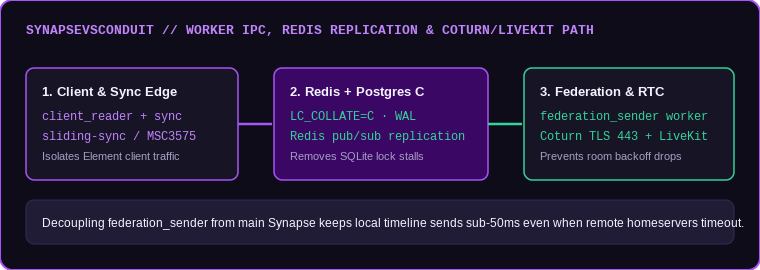
Why External syncv3 Proxies Multiply RAM and Database Load
Legacy Element X deployments pair Synapse with an external sliding-sync proxy process that maintains its own PostgreSQL database and live poller loop per user. Under mobile reconnect storms, both Postgres instances hit max_connections limits simultaneously.
Switching to Native Simplified Sliding Sync (MSC4186)
Modern Synapse v1.115+ and Continuwuity implement native MSC4186 Simplified Sliding Sync directly inside the homeserver, eliminating the standalone syncv3 proxy container and its secondary Postgres schema.
Measured Thresholds & Configuration
| Sliding Sync Mode | Extra RAM Overhead | Postgres Connection Count |
|---|---|---|
| External syncv3 Proxy + PG | +400 to +950 MB | 50 - 140 connections |
| Synapse Native MSC4186 | +90 to +180 MB | Shared pool (15-30 conns) |
| Continuwuity Native MSC4186 | +15 to +35 MB | Zero Postgres (embedded RocksDB) |